lifewater in africa

. Ndola and SHIP

     Water Wells

     Hygiene Training

     Bio-Sand Filters

. 2006 Lifewater African Partners Conference

. Epilogue: Stories from the Field


CLICK HERE TO RETURN TO LIFEWATER

lifewater in africa: the full story
Copyright © 2006 by Jeff Bjorck. All rights reserved. 
Reproduction without permission is prohibited.

Travel: Wednesday, May 31 – Friday, June 2
I met my travel partner, Kirk Schauer, at LAX on Wednesday evening. Kirk is an associate pastor of the Santa Maria, CA, Vineyard Church, and he is also the director for Seeds of Hope International Partners (SHIP). SHIP is a Lifewater partner with its headquarters in Ndola, Zambia. In short, this means that Lifewater trained and helped equip the leaders of SHIP to be able to train local Nationals in Ndola regarding safe water access, hygiene, and sanitation. This is a great example of Lifewater’s model of “training trainers to train.” Kirk and I had ample time to get acquainted on our 29-hour trip!

NDOLA and SHIP: Friday, June 2 –Wednesday, June 7
After what seemed like days (because it actually was!), we landed in Ndola. After getting through customs without too much trouble, we drove to the SHIP headquarters a few miles outside the center of Ndola. It consisted of a converted private residence on loan from a Zambian gentleman with a heart for helping his people. I had my own room, where I slept on a mattress on the floor with my mosquito net protecting me from the nightly malaria messengers. The house was in moderate to considerable disrepair, but it was clearly serving the purpose of a central location for this team. I met the team, including several members from the USA who had been serving for three months and were leaving in several days for a break back home. Already, these team members were enthusiastically speaking of returning to Ndola.

I also meet Pastor Frances Faruka, a Zambian gentleman who left a successful accounting career six years ago to enter full-time ministry. He pastors a Vineyard church in a local rural slum settlement named Chipulukusu, which means “wicked” or “cursed.” Frances and the other local pastors have committed to renaming this settlement “Mapalo,” which means, “Blessing.” Mapalo is a settlement of some 65,000 persons living in mud brick homes with open hand-dug wells. Such conditions doubtless inspired the “cursed” naming of this area. The lack of hygiene and sanitation knowledge was evidenced by the latrines which were often built close to wells and homes. As a result of leaching, the groundwater is contaminated there, making well drilling useless. Moreover, during the six months of rainy season, the dirt roads are completely unusable and flooding results in even more contamination of the open, hand-dug wells. It is no surprise that waterborne diseases are rampant.


A typical mud brick, tin roofed him in Mapalo. This home has no well and no latrine.

Such poverty has it contrasts in Ndola, however. I once accompanied two of the women serving with SHIP downtown to the local Shoprite supermarket for groceries. Security guards were plentiful and carried clubs, supposedly to deter theft. Aside from this difference, however, the store was comparable to any midsized supermarket in the United States. Thus, I was introduced to the stark disparities within Zambian culture, where bleak poverty can sit adjacent to far more comfortable amenities. Indeed, the drive through some of the neighborhoods afforded views of nicely manicured, well-painted, walled properties with most modern conveniences. Such homes, however, could be within only two blocks from a more common picture of homes made of mud or cement and small wooden shelters serving as grocery markets. In addition, electrical power frequently fails even in the best of neighborhoods, as does municipal water, reminding me that I was very far from home.

Sunday Church: Mapalo Style
While in Ndola, a highlight was attending the worship service at the Mapalo Vineyard, a tin-roofed open-air structure supported by wooden poles. Although 100 to 150 typically attend, there were only perhaps 50 or 60 congregants attending that day, due the unusually cold and windy weather (the temperature was a chilly 69 degrees Fahrenheit!). I was glad for the lack of walls because they would have blocked the magnificent 360° panoramic view of the flat African landscape stretching out as far as I could see. Even with only around 50 people, the singing rang out with loud enthusiasm. The worship team consisted of two young ladies, a young man with a guitar, and another young man playing a dilapidated electronic keyboard attached to a car battery. Some songs were in English, the official second language spoken by almost all Zambians. For the remaining songs I could not understand the words, but the hearts of those singing were easy to translate. I was asked to speak, as was Kirk, with Pastor Frances translating. There was also a time of sharing, where several individuals testified how coming to know Jesus Christ personally as Lord and Savior had made a huge difference in their lives. I was deeply encouraged to see that this local Lifewater Partner (SHIP) was offering not only physical but also spiritual resources.


Mapalo church members sing and worship. The SHIP drill rig is to the right at the nearby school.

Water Wells: Giving Life, Health, and even Literacy!
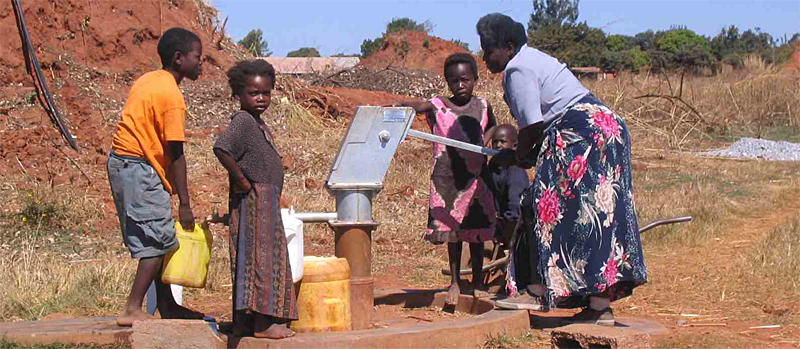
A prime example of physical resources was located within 100 feet of the church “building,” in the form of a working hand pump and an adjoining water tank sitting 20 feet high atop a massive ant hill (an African amenity). Every time this pump is used to fill a villager’s bucket, the water tank also receives water. This tank is thus continually filled and provides pressurized water to irrigate nearby crops. 


 Kirk and Jerry celebrate the tank!


Pastor Frances celebrates the irrigation!


I watched as two young girls filled two 5 gallon containers, placing their 80-pound burden (40 pounds each) in a wheelbarrow for the walk home. As strenuous as this may sound, they were fortunate to have the convenience of a wheelbarrow. Moreover, they only needed to travel a mile, which is a short walk compared to the 3 - 4 miles trekked by many around the globe in their pursuit of water. In addition, the water these two girls carried was clean and free of disease, in contrast to that obtained by 1.1 billion people in the world without access to safe water.

.
These two girls prepare for the walk home with their eighty-pounds of safe water.

The benefits of such a well multiply quickly. For example, several of the women working with SHIP conduct a literacy program for women at the Mapalo Vineyard church site. These local women are highly motivated, many walking for miles to get there, with their babies on their backs. Were it not for wells like the one next to the church, however, these women would have no time to learn to read because obtaining water would be an all-day affair. Indeed, around the globe, this task is typically relegated to women and girls. Because of the available water here, however, these Mapalo women could focus on learning to read and write in both Bemba (their language) and English.


This young mother studies long hours which otherwise would be needed for getting water.

 
This woman is very willing to teach me some Bemba words she has learned.


Unfortunately, they were having some difficulty concentrating on the day we visited, due to the fact that one young mother’s toddler was snatched by kidnappers that morning. When I asked Pastor Frances to help me understand why anyone would steal a small child in this poor rural area, his answer quickly helped me understand why the women were so upset. He explained that toddler kidnappings like this one are not rare and that the small children are taken for the purpose of ritual murders by those in Satanic cults. “Such groups are not uncommon here,” he said. Hearing this, I realized even more fully why local pastors desired to change the settlement’s name from “wicked, cursed” to “blessing” (Mapalo).


Cement blocks serve as seats in this open-air classroom. 

A second example of safe water’s impact was in progress about 200 yards away from the Mapalo Vineyard church. Here, the SHIP drill crew was busy with a well that would eventually rescue a school building project begun by another local church.


Drilling projects provide steady jobs to these hardworking local men who take pride in their work. 

This church had built a cement block school, complete with flush toilets and a septic system. Sadly, however, the municipal water supply lacked sufficient pressure to reach the school, and the toilets still sat in their packing cases. 


Children ages 7 to 18 crowd this small room. For now, bathroom breaks don't include a bathroom.

I spent several hours over several days watching as the SHIP drill crew proceeded with a well that will serve this school with the same pump-to-elevated water tank technology used by the Mapalo Vineyard church. Their drilling was arduous work and this well might take a week or more to complete. Still, I was deeply encouraged to know that safe water would be available soon, and these school children would be able to focus more on their studies and less on fighting waterborne illnesses.


The group celebrates progress at the drill site outside the school. Soon, safe water will flow!

Hygiene Training: Saving Lives Through Education
Even before this well would be completed, however, these children were already benefiting from improved health, due to SHIP’s hygiene trainings program presented at many local schools. This technique has been shown to be effective in teaching adults, too, because the children return home and tell their parents what they have learned. Pastor Frances estimated that in just the past three years, thousands have already been impacted by these hygiene trainings. His wife Flavia, a nurse who provides in-home care for HIV/AIDS patients, serves as a hygiene “trainer of trainers.” She conducts trainings for those who will then train in schools and surrounding villages. From these hygiene trainings, locals learn much more than the importance of hand washing. They also learn that loose farm animals lead to increased illness and that latrines must be built far from water sources. They learn that standing water is not only unhealthy to drink but also provides breeding ground for the mosquitoes that spread malaria. They learn that simply straining water through a tightly woven piece of cloth can totally prevent cholera. Indeed, there is much that can be taught, and the benefits are great! 

In addition to SHIP’s hygiene trainings, Pastor Frances estimated that SHIP pump repairs (110 in the last three years) and well drilling (11 in this their first year of operation) have benefited thousands more. If only 200 people use each well each day and bring water back for families of 5 (and many families are larger), then each well would serve 1000 people, providing safe water to a total of 121,000. This might seem like a high estimate, but the frequency with which pumps break due to constant overuse clearly illustrates that—if anything—this assessment may be low. Given that Mapalo alone has 65,000 residents, the estimate quickly becomes even more plausible.

Bio-Sand Filters: Bringing Hope to Mapalo
Whereas drilling wells and repairing pumps clearly makes a tremendous impact, there are many areas such as Mapalo itself where a properly drilled well is worthless due to groundwater contamination. In such places, the work of SHIP’s new bio-sand filter crew is bringing solutions and hope. These hardworking young men spend their days manufacturing filters, each of which can serve 20 people. They refer to these filters as “God’s water filtration design in a box.” Fashioned from cement and some plastic tubing, these remarkably simple devices consist of a chimney-like concrete box roughly 3.5 feet tall with an 8-inch square opening, filled with several inches of gravel followed by several feet of coarse sand. Water is added to submerge both gravel and sand, and a thick layer of algae grows on the water surface in about two weeks. 

  Thereafter, when any water is poured into this filter, safe water flows out of the nozzle in the front of the box at the impressive rate of 1 liter per minute. Amazingly, this water is 97% free of pathogens! The algae actually eat a significant portion of the contaminants, the coarse sand traps more, and the remaining bacteria are suffocated due to lack of oxygen. In short, the filthy fluid from a hand-dug Mapalo well can enter the filter bearing E. coli bacteria but exit as a clear and safe, life-giving drink.


After the filters are cured and dried, the crew patches all holes by hand and then waterproofs each filter.


Producing 1 liter/minute of safe water makes for a very happy bio-sand filter!


Perhaps the greatest highlight of my trip was being present for the installation of the first bio-sand filter in a Mapalo home. The local SHIP leaders wisely chose to place their first demonstration filter with a crew member, who would obviously know the value of such a device as well as how to properly use and maintain it. This


He must draw his family's water with a rusty paint can on the end of a pole from this open, contaminated, hand-dug well. Pouring this dirty water through the bio-sand filter purifies it!

young man and another crew member carried the filter carefully into the “living room” of his mud brick home and placed it in a corner on the dirt floor, six inches from both walls. When I suggested that he might place it right up against the corner to save space, he explained that he did not wish to scratch the paint…on the filter! This young man was already demonstrating his deep appreciation for his filter’s value as well as pride in the work that went into making it. When the installation was complete, Pastor Frances, Kirk, and I dedicated this first filter with prayers of thanksgiving and blessing for the young man’s family. He had a wife and three very small children who doubtless had already suffered often from waterborne diseases such as diarrhea, which itself can be deadly. Now the cycle of disease and death could be replaced with life and health. Hopefully, everyone in Mapalo will one day have safe water to drink!


No longer will these three little ones or their parents need to suffer with waterborne disease!

After six eventful days, Kirk and I said our good-byes to the SHIP staff and prepared to travel south to Lusaka by bus, where we would participate in the 2006 Lifewater African Partners Conference. It is remarkable how quickly one can feel bonded with new friends. I was truly sad to leave Ndola. On a happy note, Jerry, a SHIP staff member, had blessed me with the use of his cell phone before he returned to the USA for a break. This unexpected gift enabled me to talk with my wife Sharon every night for the remainder of my time in Zambia, for only 15 cents a minute! There is something truly amazing about hearing the voices of those you love, especially when they are literally half-way around the world from you. Being able to share our days with each other by phone was truly wonderful! Because the stars are all different in the Southern Hemisphere, this was the first time that Sharon and I were looking up at two different night skies, which made the distance between us seem even farther, and the blessing of a phone all the more precious. Together, we thanked the God who had made all the stars in both hemispheres!

The bus ride to Lusaka was to take about three hours, but it was a four-and-a-half-hour journey because the driver made several “unofficial stops” to let off and/or pick up friends along the way. The journey was hot and dusty, but the road was acceptable, and we arrived in Lusaka safely as the moon rose. We were picked up by Evans Chiyenge, the owner of the house used as SHIP headquarters in Ndola, and driven to the Go Center Christian conference center which would serve as our accommodations in Lusaka. This compound, which houses an HIV/AIDS health clinic, a school, a church, and a lodge, is graciously hosted by missionaries Helmut and Esther Reuter. Esther is a registered nurse and Helmut left his career as an engineer when the couple began fulltime ministry. Not surprisingly, their many pursuits include focusing on health, sanitation, hygiene and safe water, and they have also been Lifewater Partners since 1992. When we arrived at our room, the clean beds, pre-hung mosquito nets, and hot showers (well…hot for 3 minutes…if you were first!) were certainly welcome contrasts to our Ndola stay. Sleep came quickly!

Click here to read about LIFEWATER AFRICAN PARTNERS CONFERENCE: